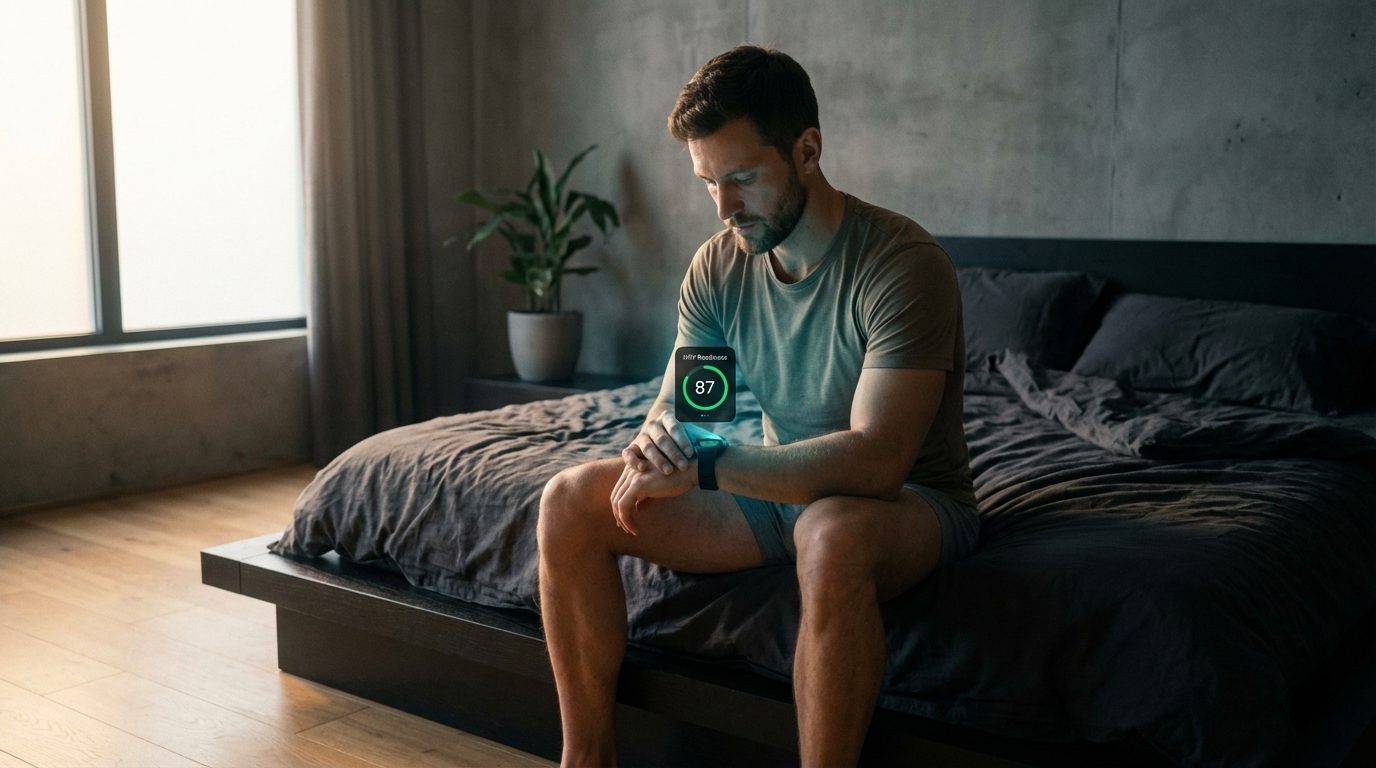
You wake up. Your alarm went off at 6am. You have a hard interval session scheduled. Your legs feel okay-ish. You’re not sure if you’re ready for it.
Heart rate variability — HRV — is the metric that answers that question more reliably than anything else currently accessible to consumer athletes. Here’s why.
What HRV Actually Measures
Your heart doesn’t beat with perfect mechanical regularity like a metronome. Even at rest, there’s slight variation in the time between beats. That variation — measured in milliseconds — is HRV.
Counterintuitively, more variation is generally better. High HRV indicates that your autonomic nervous system (specifically the parasympathetic branch — the “rest and digest” system) is active and dominant. Low HRV indicates that the sympathetic nervous system (the “fight or flight” system) is activated — which happens when your body is stressed, whether from training, poor sleep, illness, or psychological pressure.
This is why HRV predicts recovery. When your body is working hard to adapt, repair, or fight off something, HRV drops. When you’re well-recovered and ready for hard work, HRV is elevated.
Why HRV Beats Heart Rate for Recovery Tracking
Resting heart rate is useful but blunt. It rises when you’re overloaded or unwell, but the signal is noisy and slow to respond.
HRV responds faster and more sensitively. It picks up on:
- Poor sleep quality (even if duration was adequate)
- Accumulated training load
- Low-grade illness before you feel symptoms
- Psychological stress (travel, work pressure, relationship stress)
- Alcohol — even a small amount tanks HRV reliably
The combination of all these inputs means HRV gives you a window into your physiological state that neither heart rate nor subjective feel provides alone.
How to Measure It
HRV is best measured first thing in the morning, before you get up, while you’re still calm. Many wearables now measure HRV overnight and report a morning score automatically.
Apple Watch measures HRV during sleep and writes the data to Apple Health. PeakPulse reads this data automatically — no manual logging required.
A single HRV reading is not very meaningful. What matters is your trend relative to your own baseline. Your HRV range is individual — some athletes naturally have low absolute HRV numbers but are still well-recovered within that range. Compare yourself to yourself, not to published averages.
The Daily Readiness Score
PeakPulse combines three inputs every morning to calculate your Daily Readiness Score — a single number from 0 to 100:
- HRV — from Apple Health (measured overnight by Apple Watch or compatible device)
- Resting Heart Rate — also from Apple Health
- Sleep — duration and quality data from Apple Health
The algorithm weights these against your personal baselines and recent training load. The result is a score that answers the practical question: how ready is my body for hard work today?
- High score (75–100): Green light. Your body is primed to handle intensity. This is a good day for threshold work, intervals, or a long hard ride.
- Moderate score (50–74): Amber. You can train, but consider adjusting intensity downward or choosing a lower-stress activity mode.
- Low score (below 50): Recovery day. Your body is still processing stress from previous load. A Zone 2 spin or rest will serve you better than grinding through a hard session.
Your PeakPulse AI coach sees your Readiness Score before your session starts and factors it into coaching cues. If your score is low, the coach won’t push you to hold threshold power — because forcing it when your body isn’t ready produces worse adaptation and higher injury risk.
The Practical Upshot
Most athletes who start tracking HRV report the same experience: within two to four weeks, they start recognising patterns. Low HRV days that they would previously have “pushed through” turn out to be the sessions that feel terrible and produce no training benefit. High HRV days that match felt readiness turn out to be when they break personal bests.
The data isn’t magic — it’s a more accurate signal than feel alone. Combined with training load tracking (CTL/ATL/TSB), it gives you an honest picture of what’s going on under the surface.
PeakPulse reads your Apple Health HRV and sleep data automatically and calculates your Daily Readiness Score before every ride. Join the early access list to try it.