When Zwift launched, it changed indoor cycling. Suddenly you weren’t just grinding on a turbo in a dark room — you were riding through Watopia, drafting strangers, chasing KOMs on virtual climbs. For a lot of people, that social, visual immersion was exactly what they needed to make indoor training sustainable.
But not everyone wants to ride through a cartoon world.
Some athletes find the fantasy world distracting. Others just want a clean, goal-oriented session without managing avatars, power-ups, or chasing riders they can’t keep up with. Some people simply don’t want to spend the money on a full Zwift subscription for something they’ll use twice a week on a wet Wednesday.
Summit Spinner was built for those riders.
The Concept Is Simple
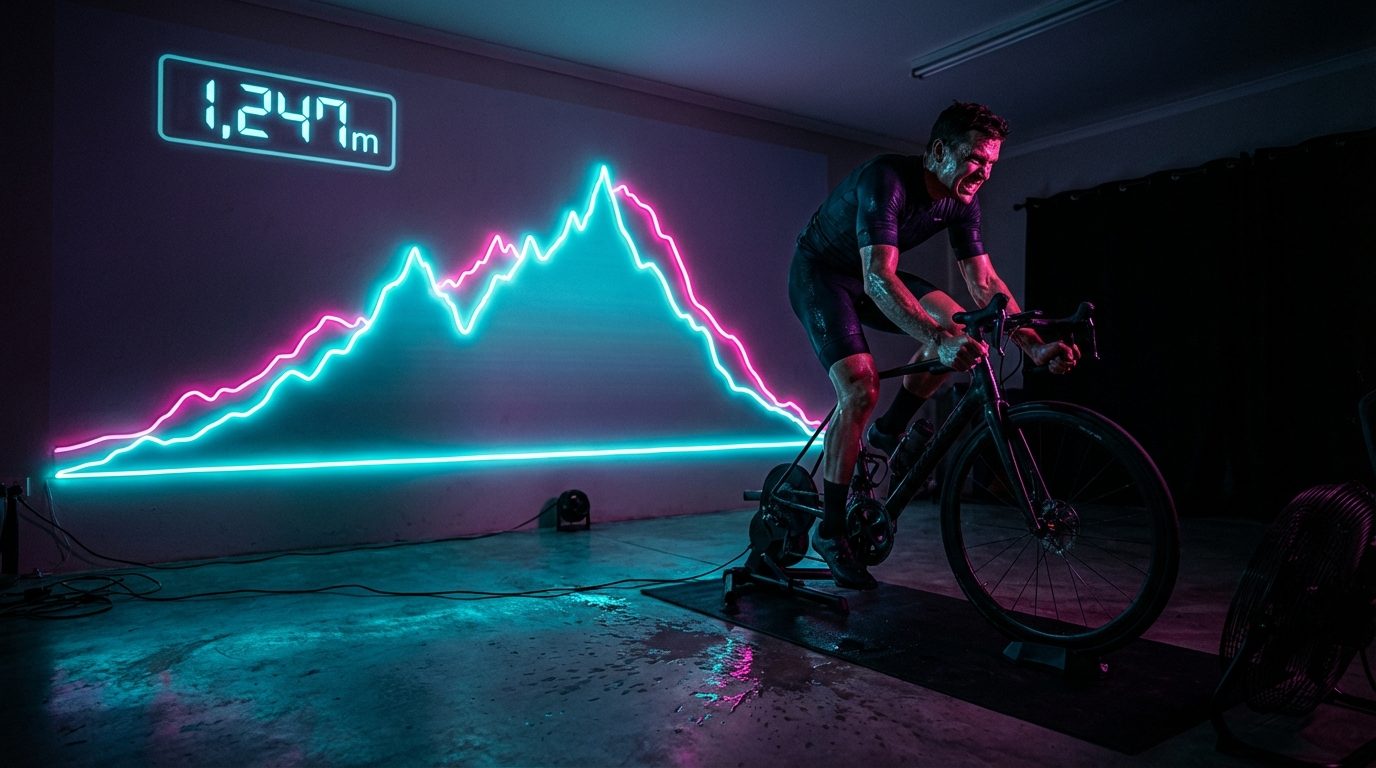
Set an elevation target. Ride. Watch your altitude rise.
That’s it. Your power output translates directly into vertical metres. Ride harder, climb faster. Back off, and the climb slows. Hit your target, and you’ve summitted.
There’s something deeply satisfying about this. Elevation is one of the most intuitive metrics in cycling — every outdoor rider understands what it means to climb 1,000 metres. Summit Spinner takes that familiar goal and makes it the entire focus of your indoor session.
How the Elevation Calculation Works
PeakPulse uses your real-time power data to estimate the equivalent gradient effort. The harder you push relative to your FTP, the faster your virtual altitude increases. This means:
- A steady threshold effort produces a consistent climb rate
- Surges above threshold accelerate your altitude gain
- Recovery periods at low power let you “descend” slightly or hold position, depending on your settings
This creates a natural interval structure without prescribing one. You can ride Summit Spinner as an all-out FTP effort, a longer endurance climb, or anywhere in between.
The Rank System
Summit Spinner tracks your elevation totals over time and awards ranks as you accumulate metres:
- Alpine Sprout — You’re finding your legs on the lower slopes
- Summit Seeker — You’re consistently putting in serious climbing work
- Peak Predator — You’ve earned the summit. Multiple times.
The ranks aren’t arbitrary — they represent real cumulative climbing effort. They give you something to work toward across sessions, not just within them.
Your AI Coach in Summit Spinner
Summit Spinner isn’t a solo experience. Your PeakPulse AI coach is active throughout, reading your power and effort relative to the climb’s demands.
If you’re pushing too hard at the start of a long elevation target, your coach will flag it — because blowing up halfway through a virtual climb is just as demoralising as it is on real roads. If you’re sandbagging on a short sprint target, your coach will call that out too.
The three coaching styles work the same way here as in any other mode. Motivational coaches treat it like a real ascent. Technical coaches give you power targets for each phase. Minimal coaches stay quiet unless you drift significantly off course.
What’s Coming Next
Summit Spinner is the first of four planned activity modes. Coming next:
- Map Explorer — Ride real-world GPX routes with terrain-aware coaching
- Race Day — Live events with other PeakPulse riders, AI pacing strategy
- Pain Cave — Structured high-intensity intervals with nowhere to hide
Each mode is designed around a specific training context. The common thread is your AI coach — present in every mode, adapting to the session, keeping you working at the right level.
Summit Spinner is available now in the PeakPulse early access build. Join the waitlist to be among the first to ride it.